Manaslu Circuit Trek 11 Days

  • Duration 11 Days
  • Destination Nepal
  • Trip Grade moderate
  • Starts at Kathmandu
  • Ends at Besisahar
  • Meals Menu
  • Accommodation Tea houses
  • Max. Altitude 5106
  • Activity Trekking
  • Group Type All Type
  • Group Size 2 to 20
  • Best Season Autumn and Spring

Highlights of Manaslu Circuit Trek

  1. Encounter the eighth-highest mountain in the world, Mount Manaslu.
  2. Experience the local culture and lifestyle.
  3. Walk through lush forests and cold desert landscapes.
  4. Reach the highest elevation of 5,106 m at the top of Larkya La Pass.
  5. Explore the Manaslu Base Camp area.
  6. Experience the biodiversity of Nepal.
  7. Have an opportunity to encounter wild animals.
  8. Experience the hospitality of local tea houses.

Manaslu circuit trek 11 daysManaslu Circuit Trek Overview

One of the most off-the-beaten-path and popular trekking routes in Nepal is the Manaslu Circuit Trek. This trek promises natural beauty and local culture with great diversity. Mount Manaslu (8163m), the eighth-highest mountain in the world, standing along the trail, makes this trek even more interesting for trekkers.

The Manaslu Circuit Trek 11 days offers different types of biodiversity in one trek. Trekkers can walk beside the Budhi Gandaki River through pine and lush forests and also experience the cold desert landscapes at higher elevations. This trek offers an opportunity to experience the local culture and local cuisine, along with monasteries and stupas along the way.

Trekkers can also visit Manaslu Base Camp via Birendra Lake, which was named after the late King Birendra Shah of Nepal.

Difficulty of Manaslu Circuit Trek

The Manaslu Circuit Trek is considered a moderate trek in Nepal due to the high elevation of Larkya La Pass and the duration of daily walking.

During this trek, trekkers have to walk approximately 7 to 8 hours a day in the lower elevations and around 5 to 6 hours a day in the higher elevations.

Trekkers should be trained to walk for around 7 hours a day before doing this trek. Regular walking and hiking practice can help trekkers prepare for the long walking days.

Permits for Manaslu Trek

The Manaslu Circuit Trek is a restricted-area trek because of its location near the regional border with Tibet. Therefore, trekkers need different permits to complete the trek.

The required permits are as follows:

  1. MRAP (Manaslu Restricted Area Permit) – USD 100 for 7 to 15 days.
  2. MCAP (Manaslu Conservation Area Permit) – USD 30.
  3. ACAP (Annapurna Conservation Area Permit) – USD 30.
  4. Chum Nubri Local Development Fee – USD 10.

Permit costs can change according to government regulations and the trekking season, so trekkers should check the latest rates before starting the trek.

Cost for Manaslu Circuit Trek 11 Days

The Manaslu Circuit Trek 11 Days will cost approximately USD 1,000 to USD 1,200, depending on different factors such as the itinerary, accommodation, transportation, and other services.

Within this budget, trekkers can get a professional guide, a porter for two trekkers, all required permits, accommodation, and food, depending on the trekking company’s package.

Trekkers should also carry some extra money for personal expenses such as monastery fees, hot showers, gadget charging, tips for the guide and porter, snacks, drinks, and other personal expenses.

Best Time to Visit the Manaslu Region

The best seasons to do the Manaslu Circuit Trek are spring and autumn. However, the trek can also be done in other seasons depending on the weather and trail conditions.

Spring Season

Spring offers clear skies and blooming trees, which make the Manaslu Trek even more attractive. The mountain views and forests are beautiful during this season.

Autumn Season

Autumn generally offers good weather and moderate temperatures, making it a suitable season for trekking in the Manaslu region.

Accommodation and Food During the Manaslu Circuit Trek

During the Manaslu Circuit Trek, trekkers will spend the nights in typical Nepali tea houses. Most tea houses have twin-sharing bedrooms and common or shared western-style toilets.

The lodges usually provide a blanket in the room. They also provide different types of food from their menus, such as dal bhat, chapati, spaghetti, chow mein, and many other dishes.

Trekkers normally have their dinner and breakfast at the same hotel or tea house where they stay overnight.

Manaslu Circuit Trek Distance and Duration

The classic Manaslu Circuit Trek is roughly 160 km to 180 km, which can be completed in 12 to 16 days, depending on the itinerary.

The trek mostly begins from Macchakhola or Soti Khola and ends around Besisahar. Trekkers may have to walk approximately 10 km to 20 km per day, depending on the route and itinerary.

Larkya La Pass – The Highest Point of the Trek

The highest point of the Manaslu Circuit Trek is Larkya La Pass at 5,106 m above sea level. At this elevation, trekkers can directly experience the thin air and high-altitude environment.

During the Larkya La Pass crossing, trekkers have to start the trek early in the morning because the weather can become windy later in the day, especially at an elevation of around 5,106 m.

Required Fitness and Preparation

The standard 11-day Manaslu Circuit Trek is considered a moderate trek in terms of difficulty. Therefore, trekkers should do basic training before starting the trek.

Trekkers should practice walking for around 7 to 8 hours a day, including walking on uphill and downhill trails. They should also be physically and mentally prepared for the challenges of long walking days and high elevations.

Manaslu Circuit Trek vs Annapurna Circuit Trek

The Manaslu Circuit Trek and Annapurna Circuit Trek are both considered moderate to challenging treks in Nepal. Trekkers should be physically and mentally prepared for the long walking days and high elevations.

In comparison, the highest elevation of the Annapurna Circuit Trek is slightly higher than that of the Manaslu Circuit Trek. The highest points are 5,416 m at Thorong La Pass for the Annapurna Circuit and approximately 5,106 m at Larkya La Pass for the Manaslu Circuit.

The accommodation on both treks is quite similar, as trekkers mainly stay in local tea houses and lodges. The types of food available on both trekking routes are also quite similar, with popular dishes such as dal bhat, noodles, chow mein, pasta, chapati, and other local meals.

The Annapurna Circuit Trek traditionally begins around the Besisahar area, while the Manaslu Circuit Trek continues toward the Dharapani area, where the two trekking routes connect. From Dharapani, trekkers can continue toward the Annapurna region.

Both treks offer spectacular mountain scenery. The Annapurna Circuit provides views of the Annapurna mountain range, including Mount Annapurna I, the 10th-highest mountain in the world, while the Manaslu Circuit offers spectacular views of Mount Manaslu, the eighth-highest mountain in the world.

In terms of cost, the Manaslu Circuit Trek can be more expensive than the Annapurna Circuit Trek because the Manaslu region is a restricted trekking area and requires additional permits and a more controlled trekking arrangement.

Overall, both treks offer beautiful mountain landscapes, local culture, traditional villages, forests, rivers, and high mountain passes. The main differences are the route, permits, cost, trekking environment, and level of development along the trails.

Why Manaslu Circuit Trek 11 Days?

The classic manaslu trek offers stunning mountain views, forests, landscapes, the Budhi Gandaki River, traditional villages, local culture, and many more experiences.

This 11-day itinerary allows trekkers to explore the beautiful Manaslu region while saving some days compared with longer Manaslu Circuit Trek itineraries. It is a great option for trekkers who want to experience the natural and cultural beauty of the Manaslu region within a shorter itinerary.
Day to Day Itinerary
Expand all

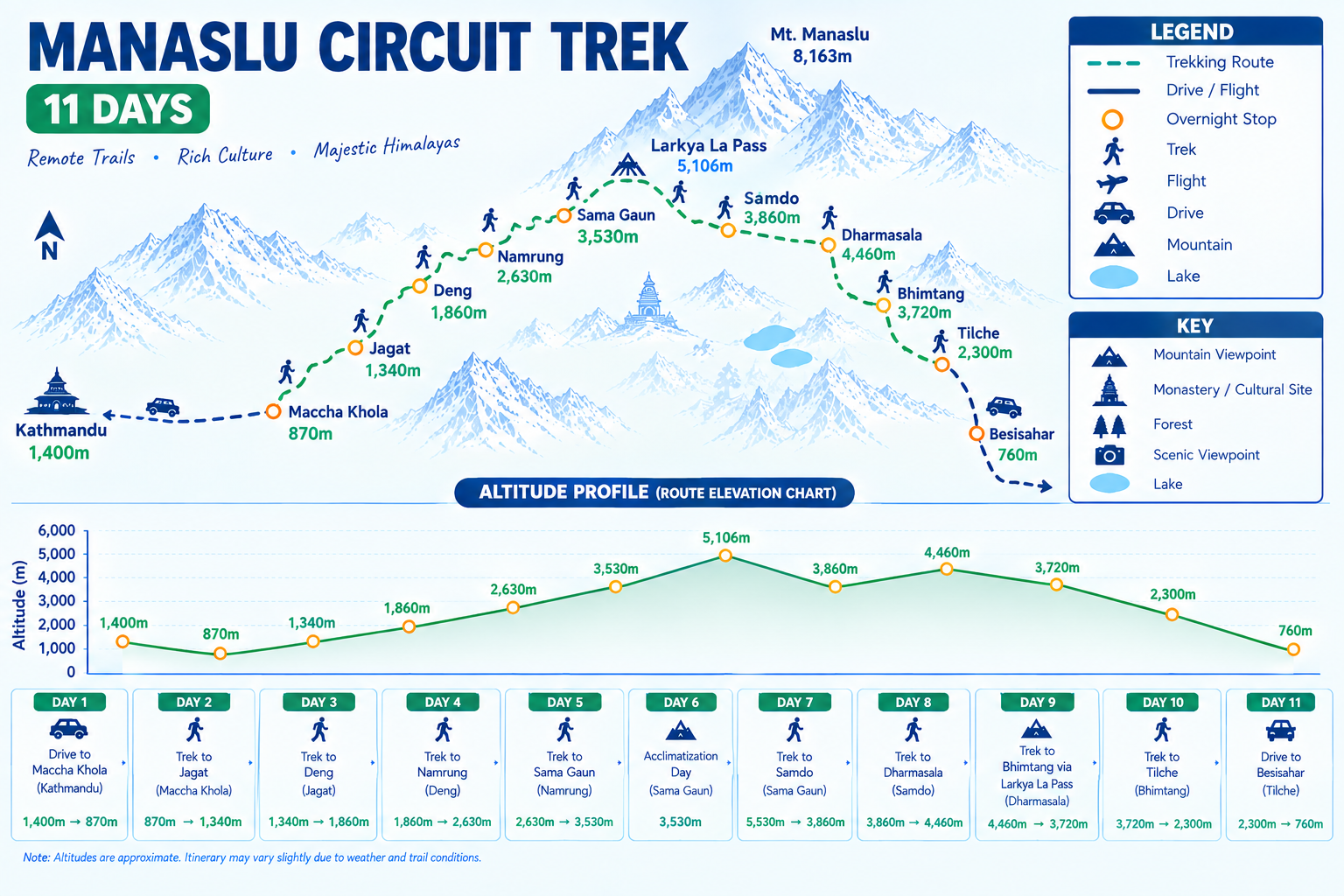
On the first day of the Manaslu Circuit Trek, the team will drive from Kathmandu (1,350 m) to Maccha Khola (870 m), covering approximately 140 km. The journey takes around 8 to 9 hours by local jeep or shared bus.

Finally, the trek begins from Maccha Khola in the morning after breakfast. Trekkers will head towards Jagat (1,340 m), which is also known as the gateway to the Manaslu Circuit Trek.

On this day, trekkers have to walk for around 8 to 9 hours, covering approximately 22 km.

After completing the permit check in Jagat, trekkers will continue towards Deng (1,860 m). The distance is approximately 20 km and takes around 8 to 9 hours.

Most of the trail on this section follows a road and can be dusty, so trekkers should carry a buff or mask to protect themselves from the dust during the trek.

On the fourth day of the trek, trekkers will head towards Namrung Village (2,630 m) from Deng. Along the way, trekkers can enjoy mountain views and experience Tibetan-influenced culture.

The distance from Deng to Namrung is around 19 km and can take approximately 7 to 8 hours to complete, depending on the pace of the trekkers.

Trekking from Namrung Village to Sama Gaun (3,530 m) is an exciting day of the Manaslu Circuit Trek. Trekkers can enjoy scenic mountain views, including views of Mount Manaslu, while passing through Lho Village, Shyala Village, and other beautiful places.

The distance is approximately 17 km and may take around 6 to 7 hours, depending on the pace of the trekkers.

Acclimatization is an important part of the Manaslu Circuit Trek because it helps the body adjust to the increasing elevation and reduces the risk of altitude sickness.

On this day, trekkers will hike towards Manaslu Base Camp (around 4,800 m) via Birendra Lake and return to Sama Gaun for the overnight stay. This allows trekkers to gain altitude during the day while sleeping at a lower elevation.

Trekkers should carry a packed lunch from Sama Gaun for the hike to Manaslu Base Camp. The round-trip hike can take around 6 to 7 hours in a day.

To allow the body to adjust to the increasing elevation, trekkers will walk slowly towards Samdo Village (3,870 m).

The trail continues beside the Budhi Gandaki River, and the distance is only around 5 to 6 km. It may take approximately 3 to 4 hours to complete the trek.

The last overnight stop before crossing Larkya La Pass is Dharmasala (4,460 m). It is relatively close to Samdo, with a distance of around 6 km, and the trek can take approximately 4 to 5 hours.

On this day, trekkers should walk slowly and comfortably to allow their bodies to adjust to the high elevation.

The most adventurous day of the Manaslu Circuit Trek is crossing Larkya La Pass (5,106 m).

Trekkers will begin early in the morning from Dharmasala and cross the Larkya La Pass before descending towards Bhimtang (3,720 m).

Crossing the pass can be challenging because of the high elevation and changing weather conditions. Trekkers should start early to reach the pass before the weather becomes more windy later in the day and to have better visibility.

After crossing Larkya La Pass, trekkers will continue towards Bhimtang for the overnight stay.

After breakfast in Bhimtang, trekkers will slowly descend towards the beautiful village of Tilche (around 2,300 m).

As the trail descends, trekkers leave the high-altitude and dry mountain landscapes behind and walk through lush and subtropical forests.

At the end of the trek, trekkers can take a shared jeep from Tilche and drive towards Besisahar.

Besisahar is a beautiful and warmer town compared with the high-altitude areas of the Manaslu region. From Besisahar, trekkers can continue their journey according to their travel plans.

Our team guides, porters and accompanying staff are locals with a broad knowledge about each and every location that we travel through.

Cost Includes

  • Airport transfers in Kathmandu (arrival and departure)
  • Domestic flights: including airport taxes (depending in itinerary)
  • All ground transportation as per itinerary
  • Accommodation during the trek in local tea houses
  • Meals during the trek – breakfast, lunch, and dinner (one item per meal)
  • Experienced, licensed, and English-speaking trekking guide
  • One local porter for every two trekkers (weight limit applies)
  • Guide and porter salary, meals, accommodation, insurance, and equipment
  • All needed permits and TIMS card
  • First-aid medical kit (carried by the guide) rip briefing before departure
  • Government taxes and service charges
  • Oximeter to measure oxygen

Cost Excludes

  • International airfare to and from Nepal
  • Nepal visa fee
  • Accommodation and meals in Kathmandu or Pokhara
  • Travel and rescue insurance (mandatory for high-altitude trekking)
  • Personal trekking equipment and gear
  • Drinks (hot, cold, and alcoholic beverages)
  • Personal expenses such as laundry, hot showers, Wi-Fi, charging electronic devices, etc.
  • Snacks, chocolates, and bottled water during the trek
  • Tips for guide and porters
  • Costs arising from itinerary changes due to weather, flight delays, or unforeseen circumstances
  • Emergency evacuation costs (unless covered by insurance)
Departure Dates

Useful Info

  • Acclimatize properly
  • Carry warm clothes (nights and mornings are cold)
  • Bring trekking poles for comfort
  • Keep cash (no ATMs on the upper trail)
  • Travel with a licensed guide for safety
  • International visitors should review visa requirements on Department of Immigration Nepal before traveling.
  • Respect local culture
  • Keep your passport during the trek
  • Insurance should cover your emergency case and atleast of 6000m altitude
  • Make sure you have enough time if you stuck in Manaslu region due to some reason

Equipment List


1. Headlamp

A headlamp is essential for early morning sunrise hikes and walking at night. Make sure to carry extra batteries if needed.

2. Sunscreen

Strong mountain sunlight can cause sunburn, even on cloudy days. A high-SPF sunscreen is highly recommended.

3. Trekking Boots

Good-quality trekking boots provide comfort, support, and protection on uneven trails, making your trek safer and more enjoyable.

4. Trekking Poles

Trekking poles help reduce strain on your knees and provide extra stability, especially on steep ascents and descents.

5. Water Bottles or Hydration Bladder

Staying hydrated is crucial during trekking. Carry at least two water bottles or a hydration bladder that can be refilled throughout the day.

6. Personal Medications

Bring your personal medications and a basic first-aid kit. Recommended items include pain relievers, medicine for altitude sickness (AMS), digestive issues, and any medications prescribed by your doctor.

7. Windproof and Waterproof Jacket

A lightweight windproof and waterproof jacket helps protect against wind, rain, and changing mountain weather conditions.

8. Down Jacket

Temperatures can drop significantly during mornings, evenings, and at higher elevations. A warm down jacket is highly recommended.

9. Sun Hat and Woolen Hat

A sun hat protects you from strong daytime sunlight, while a woolen hat helps keep you warm during cold mornings and nights.

10. Thermal Base Layers

Thermal shirts and pants provide essential warmth and comfort during cold nights and high-altitude trekking.

11. Trekking Socks

Carry several pairs of quality trekking socks to keep your feet warm, dry, and comfortable throughout the journey.

12. Slippers or Sandals

A pair of lightweight slippers or sandals is useful for relaxing your feet after reaching the teahouse each day.

13. Sunglasses

UV-protected sunglasses are important for protecting your eyes from strong sunlight and snow reflection at higher elevations.

14. Microspikes

Microspikes provide extra grip on icy or snowy sections of the trail and can be very helpful during winter or early spring treks.

15. Gloves

Warm gloves help protect your hands from cold temperatures, wind, and frost during high-altitude trekking.

16. Sleeping Bag

Most teahouses provide blankets, but they may not be sufficient during cold nights. A quality sleeping bag is strongly recommended for added warmth and comfort.

Route Map

map

FAQs

Expand all
  • The Manaslu Circuit Trek is considered a moderate to challenging trek in Nepal because of its high altitude, long trekking days, and the crossing of Larkya La Pass. Trekkers should be prepared to walk for around 6 to 8 hours per day and be comfortable with increasing altitude. Good physical fitness and proper acclimatization are important for completing the trek safely.

  • Yes, a licensed trekking guide is mandatory for the Manaslu Circuit Trek because the route passes through a restricted area of Nepal. Trekkers must follow the local permit and trekking regulations.

  • Trekkers need several permits and fees for the Manaslu Circuit Trek, including the Manaslu Restricted Area Permit (MRAP), Manaslu Conservation Area Permit (MCAP), and Annapurna Conservation Area Permit (ACAP). The Chum Nubri Rural Municipality local fee may also be required.

  • The highest point of the Manaslu Circuit Trek is Larkya La Pass, which is approximately 5,106 meters (16,752 feet) above sea level. Crossing the pass is one of the most challenging and memorable parts of the trek.

  • No. The Manaslu Circuit Trek cannot be completed independently as a solo trek under the current restricted-area regulations. Trekkers need to trek with a licensed guide and follow the required permit and group regulations.

  • Spring (March to May) and autumn (September to November) are generally considered the best seasons for the Manaslu Circuit Trek. These months usually offer more stable weather, clearer mountain views, and suitable trekking conditions.

  • Both the Manaslu Circuit Trek and Annapurna Circuit Trek offer beautiful mountain scenery and unique trekking experiences. The Manaslu Circuit is generally less crowded and passes through more remote landscapes, while the Annapurna Circuit has more developed trekking infrastructure and is easier to access. The Manaslu Circuit can also cost more because of its restricted-area permits and guide requirements.

  • The Manaslu Circuit Trek can be completed in different timeframes depending on the itinerary and acclimatization plan. 11 days is a compact itinerary, while 12, 14, or more days can provide more time for acclimatization and a more relaxed trekking experience.

  • After completing the Manaslu Circuit Trek, trekkers can travel from Besisahar to Pokhara by road. The journey allows trekkers to continue their trip with a relaxing vacation in Pokhara after completing the trek.